

HOW IT WORKS
Stable by design. Dynamic without disruption.
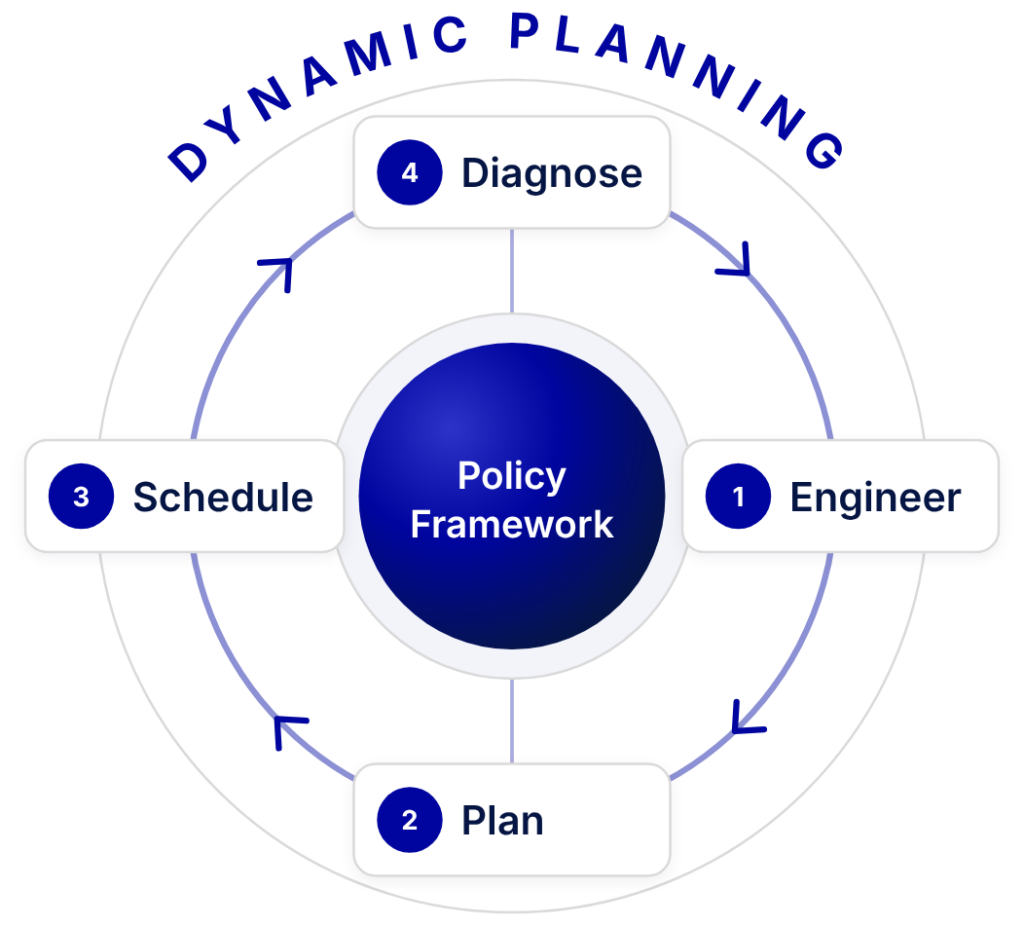
One policy framework sits at the centre of Dynamic Planning, connecting your factory, network, plan and schedule. It sets in advance what holds and what can flex, and is refined after every cycle.
SEE IT IN ACTION
When demand rises, the old way reacts. Dynamic Planning absorbs.
The old way
With Dynamic Planning
When demand rises
The old way
With Dynamic Planning
What happens to the plan
The old way
With Dynamic Planning
What the scheduler does
The old way
With Dynamic Planning
If demand stays high
The old way
With Dynamic Planning
The result
Always catching up
Always in control
WHAT MAKES THE DIFFERENCE
Most change never needs to reach the factory floor.
Dynamic Planning decides in advance what can flex in the plan, so changes in demand, supply and capacity are absorbed and the rest of the plan stays stable.
1Stable by design

Every product
A plan template sets the production rhythm.
A calendar the factory and its network run to: what’s made, when and in what order, so everyone knows what’s coming.

Best-sellers
Levelling steadies how much is made.
Best-sellers run on fixed cycles. Their quantities are levelled, so production follows the trend, not every spike.

Lower-volume products
Dampening steadies when they’re made.
Lower-volume products are made in fixed amounts. Buffers protect service until the next run, instead of changing the plan every week.
2Stable through change

Everyday change
Buffers absorb it.
Buffers protect the parts of the plan that flex, so it stays predictable.
Lasting change
Settings are updated.
Parameters update as variability changes, so fewer exceptions come up.
Sudden change
Exceptions follow agreed rules.
Your team decides in advance what flexes first, and how far.
UNDERNEATH IT ALL
One policy framework integrates planning and scheduling and keeps the network in sync.
HOW IT RUNS
Your planning cycle with SupplyVue.
1
MONTH BY MONTH
Engineer
Rules, set. Engineer recommends the rhythm your factory and network run to, from where each product is made to production cycles, batch sizes, buffers and the rules for exceptions. It explains each recommendation, and teams can test what-if scenarios first.

2
WEEK BY WEEK
Plan
The week, shaped. Plan turns the policy framework into a stable weekly plan for the whole network, within each line’s real capacity. Each site orders to agreed rules and buffers absorb everyday change, so the plan only changes when it needs to.

3
DAY BY DAY
Schedule
The day, sequenced. Schedule sequences the plan hour by hour on the same rules, so the factory keeps its rhythm and gets a plan it can carry out, using its full capacity. It offers a choice of schedules, each with its trade-off.

4
CYCLE BY CYCLE
Diagnose
Gaps, explained. After every cycle, Diagnose compares the service, stock and cost expected with what actually happened, and explains any gap. It shows where instability is costing you most and recommends what to change, for your team to approve.

Back to the start: what happened on the factory floor informs next month’s rules.
PEOPLE AND AI
Human judgement, applied at machine speed.
The policy framework is the guardrail. AI works only within the limits your team has agreed, so plans aren’t just more automated, they’re better quality.
The system computes
Day to day, SupplyVue updates the plan and schedule within your team’s limits, and flags issues early.
AI recommends
It spots where things are changing, explains why and recommends what to change.
People approve
Big decisions, like changing a policy or committing to a date, come with the options and impact laid out.
A bigger role for planners.
With fewer exceptions to handle, planners spend less time firefighting and more time shaping the policy framework, testing scenarios and improving service and cost.
GETTING STARTED
See the value before you scale.
SupplyVue starts from whatever plan you have today, so you don’t need a mature S&OP process to begin. Each step proves its value before you take the next.
About two weeks
Agree your path.
A diagnostic shows what instability is costing you and sets out the business case for change.
First months
Stabilise.
The policy framework is reset, and weekly planning settles into a steady, repeatable rhythm.
At your pace
Build from there.
Planning and scheduling are integrated, then rolled out to every factory, using common policies and measures to compare performance.
Runs alongside your systems
Whether that’s SAP, Microsoft Dynamics 365 or something else.
Starts from an extract
Step 1 works from data you already have. The connection is set up as you stabilise.
Enterprise-grade security as standard
Hosted on Microsoft Azure. AES-256 and TLS 1.2+ encryption. ISO/IEC 27001 certified.
See Dynamic Planning in action
Book a call with our supply chain engineers to see where instability is costing you, and how to fix it.